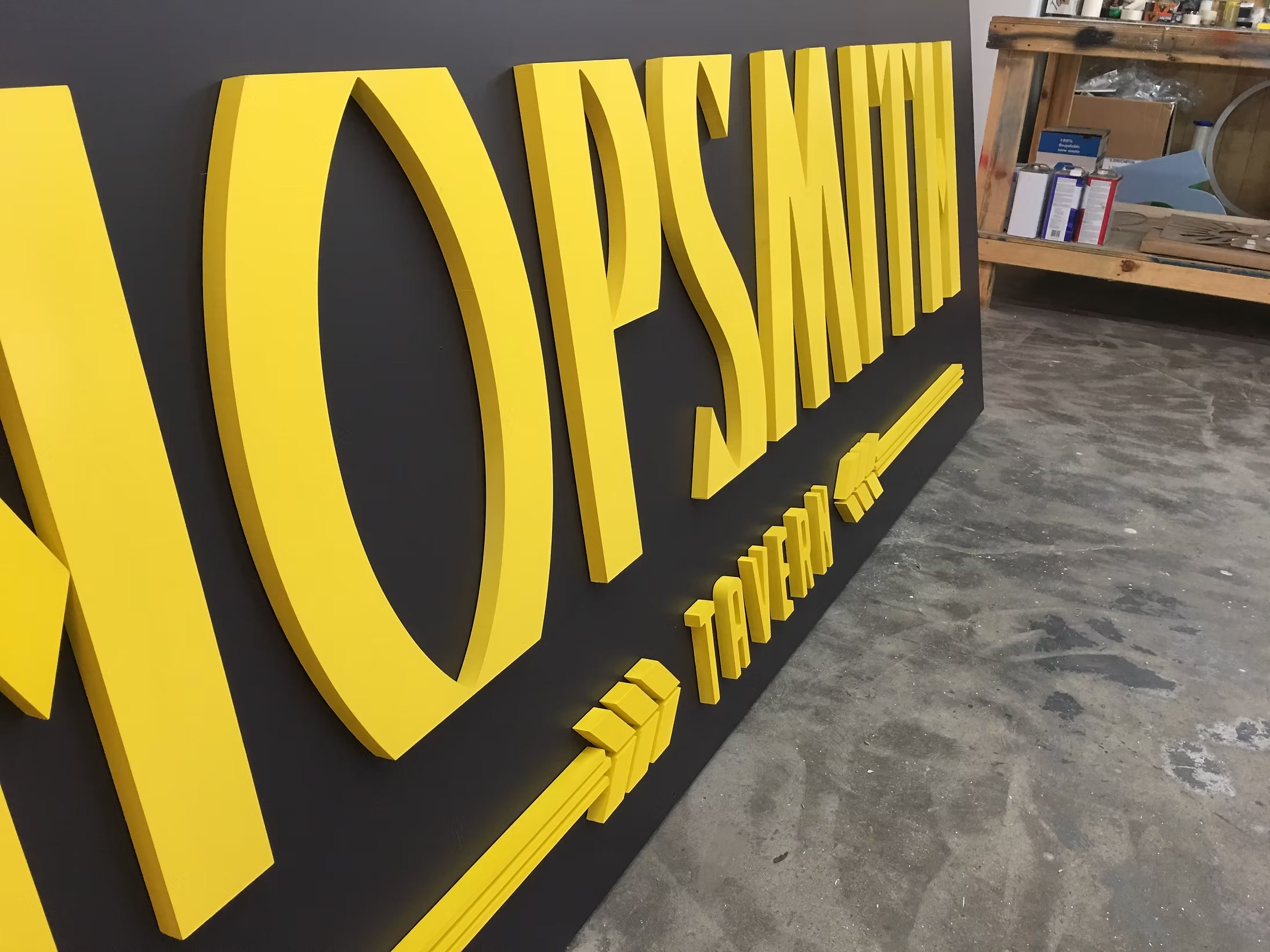
What makes this project successful
For this type of project, one of the most important goals is to select a letter height that remains readable at the intended distance. That decision affects letter height, overall scale, contrast and the amount of information the customer can absorb in a few seconds. We evaluate it at the proposed finished size rather than relying only on a logo shown on a computer screen.
For this type of project, one of the most important goals is to preserve the proportions and spacing of the approved wordmark. It also influences material, thickness and mounting preparation. A sign can look correct in artwork but still be difficult to install or too delicate to ship if the physical conditions are ignored.
For this type of project, one of the most important goals is to prepare the pieces for the wall, panel or monument where they will be mounted. Addressing this early prevents costly field changes. Photographs, measurements and a clear description of the normal viewing position are often more useful than selecting a material before the job is understood.
Sign formats and construction choices
Individual dimensional letters are a practical option. This approach can be adjusted through shape, depth, edge treatment, finish and mounting so it supports either a traditional or contemporary brand.
Connected script or logo shapes are a practical option. It works best when the artwork is simplified to the details that remain readable at the intended size. Extra effects should serve the message rather than compete with it.
Letters applied to a routed background panel are a practical option. The quote should state whether the piece is raw, primed or fully finished and whether patterns, holes, studs or other mounting preparation are included.
Details that should be confirmed before production
A frequent planning concern is total installed width and available wall space. Clear documentation before production is less expensive than correction after material has been cut or paint has been applied.
A frequent planning concern is thin strokes, isolated dots and fragile logo details. The customer, designer, manufacturer and installer should be working from the same approved revision so no one is relying on an outdated drawing.
A frequent planning concern is patterns, studs, spacers and surface-specific fasteners. When the answer depends on site conditions, the local installer or contractor should verify it in the field rather than asking the fabrication shop to guess from a photograph.
Designing custom sign letters and dimensional logo elements for people, not only drawings
The approved layout must work at the actual installation location. Viewing distance, surrounding architecture, wall color, landscaping, lighting and the speed of approaching traffic can all change what is readable. We recommend judging the design from the normal customer viewpoint, not only from a close-up proof. A simpler message with stronger contrast usually performs better than a crowded panel with every possible detail.
A custom sign is also a physical object. Thickness, routing depth, edge strength, fasteners and package size matter. Very thin logo strokes may need to be strengthened, delicate pieces may need backing, and a large panel may need to be divided for freight or installation. These adjustments are discussed before production so the finished result still represents the approved brand.
Color should be identified with a recognized physical reference whenever possible. Screens and printed office copies are useful for direction but are not reliable paint standards. Finish sheen, surrounding light and substrate can change how the same color appears. Critical brand colors should be confirmed before material is finished.
Where this service is commonly used
How a custom sign order moves forward
Send the project information
Provide dimensions, quantity, artwork, photographs, indoor or outdoor use, required date and shipping ZIP. When a sign must fit an existing opening, include thickness and mounting details.
Confirm scope and production artwork
The written quote identifies construction, finish, mounting preparation, packaging and shipping. Production artwork is approved before fabrication begins.
Manufacture and finish
Components are routed, cut, assembled and finished according to the written scope. Spelling, dimensions, color placement and visible workmanship are checked.
Package for the destination
Painted faces, edges and dimensional pieces are protected based on size and fragility. Parcel or freight shipping is selected from the completed package.
Install locally
The customer, contractor or local sign professional receives and installs the sign. Site verification, permits, structure and local code compliance remain with the project team unless separately contracted.
Information to gather before requesting a quote
A complete request produces a faster and more accurate response. Gather the following details when they are available:
- Overall available wall width
- Desired letter or logo height
- Wall material and condition
- Interior or exterior exposure
- Logo or font files
- Preferred mounting method
Do not worry if every item is not available. Send the best information you have and identify what still needs to be measured or approved. We will explain which missing details are essential before fabrication and which can be decided during the quote process.
Frequently asked questions
Can you copy letters from a photograph?
A photograph can be a reference, but an exact match usually requires the original font, logo file or redrawing.
Can the letters be painted any color?
Letters can be finished in many commercial paint colors when a recognized code is provided.
Do custom letters include an installation pattern?
A paper pattern or placement drawing can be included when specified in the quote.
Can you make script lettering?
Yes, when stroke thickness and finished size are suitable.
Are these illuminated channel letters?
Our core offering is non-electrical dimensional letters, logos and routed components.
Can sign shops order unfinished letters?
Yes. Trade buyers can request raw, primed or finished components.
Ready to discuss your sign?
Send the measurements, artwork, photographs and shipping ZIP. We will review the project and identify the next information needed for a clear quote.
Request a Custom Quote